
How to Get Traffic to Your Website (Without Wasting Years Figuring It Out)

Nobody builds a website hoping it stays invisible, so why do most of them?

I published content for months before anyone consistently showed up. The site looked right. The posts were decent. But traffic? Mostly non-existent.

What I did understand then is that traffic is a skill, and like most skills, it starts with learning a few fundamentals that nobody bothers to explain clearly.

There are three main ways people find content online: search engines, social media, and paid advertising. Each one works differently, rewards different behavior, and fits different stages of building a site.

Traffic doesn’t magically appear. It’s built through consistent effort and useful content over time.

This guide walks you through all three, what they actually are, how they work in practice, and which one deserves your attention.

1

SEO: Traffic That Builds While You Sleep

Search engine optimization is the process of creating content that search engines like Google, Bing, and even ChatGPT want to show people.

The thing I wish I had known earlier

SEO takes much longer than anyone tells you. Not weeks, but months. If you start expecting results in 30 days, you will quit before the work pays off. Once I accepted the timeline, everything changed. I stopped second-guessing every post and started focusing on building something that grows over time.

At a basic level, SEO is about understanding what people are searching for and creating content that clearly answers those questions.

When someone types a question and your page answers it clearly, search engines send that person to you. You don’t pay per click, and the traffic doesn’t stop when you close your laptop.

That’s what makes SEO the best foundation for a content-based website. It’s slow to start, but once it gains momentum, it keeps working.
seo-keyword-example-goldendoodle

How Keyword Research Actually Works

Keywords are simply the words and phrases people type into search engines. Keyword research is figuring out which phrases are worth targeting.

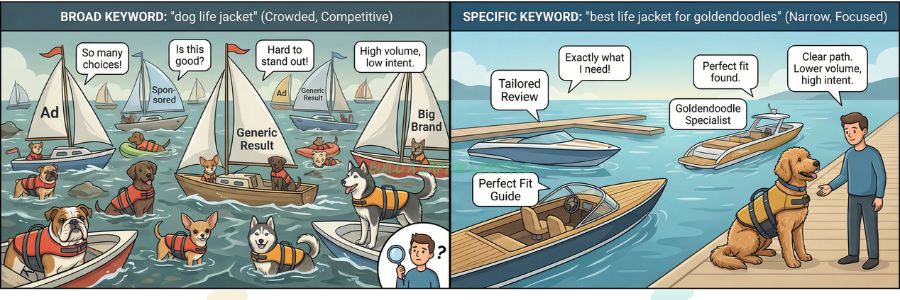
At a beginner level, you’re looking for specific, lower competition phrases that match exactly what your content covers. The goal isn’t to rank for everything, it’s to rank for keywords that:

  • Match what your content is actually about
  • Are specific, not overly broad
  • Show clear intent from the person searching

For example, “make money online” is searched a million times a day and is dominated by massive sites with YEARS of authority. But “how to make money online with a laptop as a student” is specific, shows clear intent, and is far more winnable.

Keyword research helps you avoid guessing. Instead of hoping people find your page, you are aligning your content with searches that already exist.

Search Intent: The Part Most Beginners Skip

Every search has a reason behind it. Someone typing “what is SEO” wants an explanation. Someone typing “best SEO tools for beginners” is comparison shopping. These need completely different content, even if the topic feels similar.

Before writing any page, ask yourself one question: What does this person actually want to walk away with?

If your content delivers that, search engines will notice and will begin to trust and rank your page.

Basic On-Page SEO That Actually Matters

On page SEO is how you structure and present your content, so it’s easy for both readers and search engines to understand. You don’t need advanced tools to do this well.

Some beginner friendly on page basics include:

  • Use your main keyword naturally in the page title
  • Break content into clear sections using headings
  • Write in a way that is easy to scan and read
  • Keep your content focused on one main topic

The goal is clarity, not perfection. Search engines want to see that your page stays on topic and delivers value.

Real example from our own site

A few years ago I wrote a post targeting the keyword “goldendoodle life jacket.” Not a broad dog accessories post, but one specific and focused article answering exactly what someone searching that phrase would need to know.

The post didn’t rank overnight. For the first two months, traffic was nearly zero. Around month three, it started picking up. Eventually it became one of our most consistent traffic sources, not because of any trick, but because it answered one question better than anything else out there.

That’s the SEO model in its purest form: match a specific search with genuinely useful content, then give it time to work.

Go Deeper
Keyword Research for Beginners
How to find low-competition keywords your site can actually rank for
2

Social Media: Faster Traffic, Different Rules

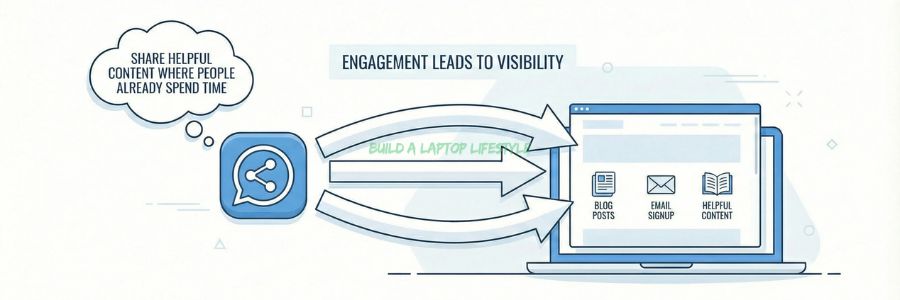
Social media can bring visitors to your site much faster than SEO, but it works differently. Instead of waiting for people to search for you, you’re placing content where people are already spending time and inviting them in.

The tradeoff is consistency. A post can perform well one day and go unnoticed the next. Social traffic is real and valuable, but it’s less predictable than search traffic. That’s why it works best as a complement to SEO, not a replacement.
The Beginner Mistake: Trying to Be Everywhere

New site owners feel pressure to post on every platform like Instagram, TikTok, Pinterest, X, and YouTube all at once. In practice, this spreads effort thin and leads to burnout with inconsistent results on every channel.

A much smarter approach is to pick one or two platforms, learn how they work, and post consistently until you see what resonates. Then, and only then, consider expanding to other platforms.

Keeping Social Media Posting Simple

Social platforms work differently to search. Nobody opens Instagram looking for your blog or an answer to a question. They’re scrolling, half-distracted, and your content has about two seconds to earn their attention.

Don’t make social media a broadcast channel, posting links and hoping people click. What actually works is showing up like a real person.

Share something genuinely useful, answer a question someone in your niche is already asking, or post something from your own experience. The clicks to your site follow naturally when people are already interested.

How my wife used Instagram to grow our dog blog

She didn’t post product links or promotional content. She posted a photo of one of our dogs actually swimming in the life jacket we’d reviewed, a candid and real moment that people genuinely responded to.

The caption shared our honest experience. The link in her bio went to the full review. People clicked because they were already interested, not because they were being sold to.

That’s the dynamic that works on social: value first, invitation second.

Go Deeper
Using Social Media to Support Your Blog
How to drive consistent traffic without burning out on content creation

PPC Tips to Grow Without Wasting Money

Pay per click advertising, often called PPC, is a traffic method where you pay to place your content or offer in front of people. The most common example is paid search ads, where your page appears at the top of search results for specific keywords. You only pay when someone clicks your ad.

PPC can work well, but it is also one of the easiest ways for beginners to lose money if they jump in too early. That is why it is important to understand how it fits into the bigger picture.

What PPC Really Means

At its core, PPC is about buying attention. Instead of waiting for traffic to build through SEO or social media, you are paying to test ideas and reach people quickly. This can be useful, but it comes with risk if you do not have a clear plan.

Unlike SEO, PPC does not reward patience. Traffic stops the moment you stop paying. That is not a bad thing, but it means you need to be intentional with how you use it.

A Simple Paid Search Example

Imagine someone searches for “best beginner side hustle.” With PPC, you can run an ad that shows your page at the top of the results for that search. If someone clicks the ad, you pay a small fee for that click.

If the page they land on is helpful and clear, that click may turn into a subscriber or a customer. If the page is weak or unfocused, the money is gone with nothing to show for it.

This is why PPC works best when you already have strong content or a proven page in place.

Why Beginners Should Start Small

One of the biggest mistakes beginners make with paid ads is assuming they are easy money. Even small daily budgets can add up quickly if ads are not set up correctly.

A smarter approach is to:

  • Start with a very small budget
  • Test one page or offer at a time
  • Pay attention to what people do after they click

PPC is most effective when it is used to test and refine, not to replace the foundation of your website.

Focus on One Page or Offer

Instead of spreading ads across multiple pages, beginners are better off focusing on a single page. This makes it easier to understand what is working and what is not.

Paid ads should support a solid foundation, not compensate for missing content or unclear messaging. When your website is already providing value, PPC can become a useful tool for growth rather than an expensive experiment.

content-marketing-basics-for-beginners

Create Content That Attracts, Connects, and Converts

No matter which traffic channel you use, everything eventually leads back to your content. SEO, social media, and paid ads all rely on having something worth clicking on. Without useful content, traffic becomes short lived and difficult to grow.

Content that performs well is not about being perfect or overly polished. It is about solving real problems and making information easy to understand. When your content helps someone move forward, it builds trust and keeps people coming back.

Focus on Solving Real Problems

The strongest content starts with a clear problem. Before creating anything, it helps to ask:

  • What question is someone trying to answer?
  • What confusion are they experiencing?
  • What result are they hoping for?

When your content is written with the reader in mind, it naturally becomes more useful. This is what search engines reward, what social platforms surface, and what paid traffic needs to convert.

Keep Content Clear and Helpful

Beginners often feel pressure to write long or complicated content. In reality, clarity matters far more than length. Simple language, clear structure, and practical explanations go a long way.

Helpful content usually:

  • Stays focused on one main topic
  • Uses clear headings and short sections
  • Explains concepts without unnecessary complexity

The easier your content is to read, the more likely people are to engage with it.

Use Simple Calls to Action

Every piece of content should guide the reader toward a next step, even if that step is small. A call to action does not have to be sales focused. It can be as simple as inviting someone to read another page, join your email list, or explore a related topic.

Clear direction helps turn traffic into engagement rather than one time visits.

Why Consistency Matters Across All Channels

Consistency is what allows traffic to compound over time. Publishing useful content regularly gives search engines more to index, gives social media more to share, and gives paid ads stronger landing pages.

Progress may feel slow at first, but consistent effort builds momentum. Over time, that momentum turns content into an asset that supports every traffic channel you use.

Summary and Next Steps

Website traffic is not something you stumble into by accident. It is built by understanding how people find content and choosing the right channels to reach them.

SEO, social media, and paid advertising each play a role, but they work best when they support a solid foundation. SEO gives you long term visibility by matching useful content with real searches. Social media helps you connect with people and bring attention to that content without waiting. Paid ads can accelerate growth, but only when your site already provides clear value.

None of these channels work in isolation, and none of them replace the need for consistent, helpful content.

If you are just getting started, focus on building that foundation first. Create content that solves real problems, stay consistent even when progress feels slow, and choose one traffic channel to learn at a time. Over time, traffic becomes something you build intentionally rather than something you chase.

Your next step is to return to the Laptop Lifestyle Hub and continue through the beginner lessons. Each section is designed to build on the last so you can move forward with clarity and confidence. When you are ready, you can explore deeper guides on SEO, social media, and paid traffic and begin applying what you learn at your own pace.

Traffic takes work, but that work compounds. Keep moving forward, stay focused, and let the process do what it is designed to do.

How to Get Traffic to Your Website: SEO, Social Media & Paid Ads
Beginner Foundation

How to Get Traffic to Your Website (Without Wasting Years Figuring It Out)

I published content for months before anyone consistently showed up. The site looked right. The posts were decent. But traffic? Mostly silence. What I didn’t understand then is that traffic is a skill — and like most skills, it starts with learning a few fundamentals that nobody bothers to explain clearly.

8 min read  ·  SEO, Social Media, Paid Ads


There are three main ways people find content online: search engines, social media, and paid advertising. Each one works differently, rewards different behavior, and fits different stages of building a site. This guide walks you through all three — what they actually are, how they work in practice, and which one deserves your attention first.

The thing I wish I’d known earlier

SEO takes much longer than anyone tells you. Not weeks — months. If you start expecting results in 30 days, you’ll quit before the work pays off. Once I accepted the timeline, everything changed. I stopped second-guessing every post and started focusing on building something that compounds.

Search engine optimization is the process of creating content that search engines — Google, Bing, even ChatGPT — want to show people. When someone types a question and your page answers it clearly, search engines send that person to you. You don’t pay per click. The traffic doesn’t stop when you close your laptop.

That’s what makes SEO the best foundation for a content-based website. It’s slow to start, but once it builds momentum, it keeps working.

How Keyword Research Actually Works

Keywords are simply the phrases people type into search engines. Keyword research is figuring out which phrases are worth targeting — meaning enough people search for them, and the competition isn’t so fierce that a new site has no chance.

At a beginner level, you’re looking for specific, lower-competition phrases that match exactly what your content covers. The goal isn’t to rank for everything. It’s to rank for the right things.

For example, “make money online” is searched millions of times a day — and dominated by massive sites with years of authority. A beginner has no realistic path there. But “how to make money online with a laptop as a student” is specific, shows clear intent, and is far more winnable.

Search Intent: The Part Most Beginners Skip

Every search has a reason behind it. Someone typing “what is SEO” wants an explanation. Someone typing “best SEO tools for beginners” is comparison shopping. These need completely different content — even if the topic feels similar.

Before writing any page, ask yourself one question: What does this person actually want to walk away with? If your content delivers that, search engines will notice.

Basic On-Page SEO That Actually Matters

Include your main keyword naturally in the page title. Use clear headings to break up sections. Write for humans first — if a real person finds it helpful and easy to read, you’re doing it right. You don’t need expensive tools or technical tricks to get started.

A few years ago I wrote a post targeting the keyword “goldendoodle life jacket.” Not a broad dog accessories post — one specific, focused article answering exactly what someone searching that phrase would need to know.

The post didn’t rank overnight. For the first two months, traffic was nearly zero. Around month three, it started picking up. Eventually, it became one of our most consistent traffic sources — not because of any trick, but because it answered one question better than anything else out there.

That’s the SEO model in its purest form: match a specific search with genuinely useful content, then wait for the math to work.

Go Deeper
Keyword Research for Beginners

How to find low-competition keywords your site can actually rank for

Social media can bring visitors to your site much faster than SEO — but it works differently. Instead of waiting for people to search for you, you’re placing content where people are already spending time and inviting them in.

The tradeoff is consistency. A post can perform well one day and go unnoticed the next. Social traffic is real and valuable, but it’s less predictable than search traffic. That’s why it works best as a complement to SEO, not a replacement.

The Beginner Mistake: Trying to Be Everywhere

New site owners often feel pressure to post on every platform — Instagram, TikTok, Pinterest, X, YouTube — simultaneously. In practice, this spreads effort thin and leads to burnout with inconsistent results on every channel.

A much smarter approach: pick one platform, learn how it works, and post consistently until you see what resonates. Then, and only then, consider expanding.

She didn’t post product links or promotional content. She posted a photo of one of our dogs actually swimming in the life jacket we’d reviewed — a candid, real moment that people genuinely responded to.

The caption shared our honest experience. The link in her bio went to the full review. People clicked because they were already interested — not because they were being sold to. That’s the dynamic that works on social: value first, invitation second.

Go Deeper
Using Social Media to Support Your Blog

How to drive consistent traffic without burning out on content creation

Pay-per-click advertising — PPC — lets you pay to appear at the top of search results or in front of targeted audiences on social platforms. You only pay when someone clicks. Done right, it can accelerate growth significantly.

Done wrong, it drains your budget fast with little to show for it. That’s not an argument against paid ads — it’s an argument for knowing when to use them.

Why PPC Isn’t the Right Starting Point

Paid traffic stops the moment you stop paying. If your site doesn’t have strong content yet — pages that convert visitors into subscribers or buyers — you’re paying to send people to a dead end. Even a small daily budget adds up quickly when nothing’s working.

Think of PPC as an amplifier. It works best once you have a proven page or offer. Then it becomes a way to scale what’s already working — not a way to test whether your foundation is solid.

The Smart Way to Start With Paid Ads

When you’re ready to experiment, start with one page and a small daily budget — even $5–10 per day. The goal isn’t immediate profit. It’s to understand who clicks, what they do after they arrive, and whether your content gives them a reason to stay.

PPC is one of the best ways to gather real data about your audience quickly. Just make sure you have something worth clicking on before you start spending.

Go Deeper
Beginner’s Guide to PPC Advertising

How to run your first paid campaign without wasting money

How the Three Channels Compare

Each channel has a different speed, cost, and longevity. Here’s a quick reference:

Channel Speed to Traffic Cost Longevity Best For
SEO Slow (2–6 mo) Time only Long-term Building a foundation
Social Media Medium Time only Post-by-post Connecting & early visibility
Paid Ads Fast Budget required While spending Scaling what already works

SEO sends people to your content. Social media promotes it. Paid ads link to it. Every traffic channel eventually lands on the same thing: a page on your website. If that page doesn’t deliver value, none of the channels matter.

Strong content doesn’t mean long content or perfectly polished writing. It means solving a specific problem clearly. When a reader finishes your page feeling like their question was actually answered, that’s the content worth building traffic to.

What makes content worth clicking on

It starts with one specific problem. Not a broad topic — the exact question someone would type into Google at 11pm when they’re frustrated.

It’s written for the reader, not for search engines. If a real person finds it useful and easy to follow, the SEO usually takes care of itself.

It tells them what to do next. A clear next step — read more, subscribe, explore a related post — turns a one-time visit into a relationship.

It’s consistent. One great post won’t build a traffic engine. A steady stream of useful content is what compounds over time.

Traffic isn’t a mystery. It’s a process — one built on understanding how people find content and giving them something worth finding. Start with SEO as your foundation. Use social media to support and share what you create. Add paid ads when you have something proven worth amplifying.

None of it happens overnight. But none of it requires luck either. It requires consistency and a willingness to learn each channel one at a time.

Ready to Build Your Foundation?

Each guide below goes deeper on one traffic channel — with practical steps you can apply to your site this week.