Are you tired of trading time for money and want to build something real online?
The 40-hour work week wasn’t built for the internet age.
I know that feeling, because I was stuck in it too. I let my own website sit untouched for MANY years. Not because I didn’t care, but because I was stuck waiting for the right moment, the right skills, the right sign. What finally got me moving forward wasn’t a course or a clever strategy. It was realizing the “right moment” was just me deciding to stop waiting.
I created Build a Laptop Lifestyle to be the roadmap I wish I had back then. You don’t need a fancy degree, expert tech skills, or luck. You need a clear, simple path to transition from an ordinary 9-to-5 to an online business you can run from anywhere.
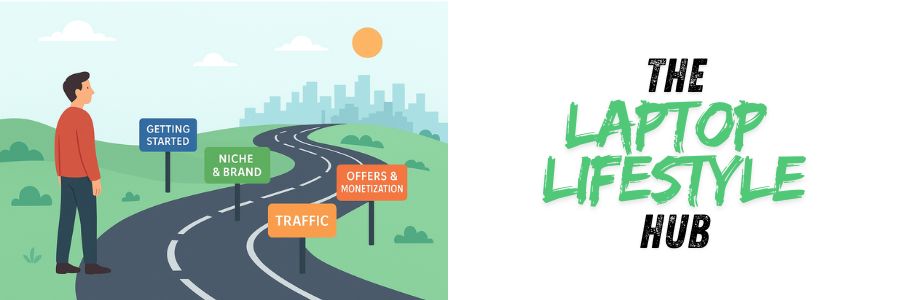
This Hub is your command center. Below, I’ve broken the journey down into four phases that mirror how this works in the real world, from the mindset shift that makes everything else possible, all the way to actually getting paid.
How to use this hub: If you’re starting from zero, follow the phases in order. If you’ve already got a site but something isn’t clicking, jump straight to the phase where you feel stuck. Each one links to a full guide with the actual steps, no fluff.
Your journey starts here
Four Phases. One Clear Path.
Phase 1
Mindset and Choosing Your Path
Most people don’t fail online because they picked the wrong niche or the wrong tool. They fail because they’re still thinking like employees, waiting for permission, waiting for a plan, waiting for a perfect moment that never comes. This is where that changes.
Worth knowing before you start
Perfectionism is just procrastination with better branding. I know because I used it as an excuse for years. The goal of this phase is to get you moving before you feel ready, because feeling ready is rarely how it works.
✓
The Permission Trap: Why the employee mindset keeps you waiting for instructions and how to break free from it for good.
✓
Choosing your model: A beginner-friendly breakdown of Affiliate Marketing vs. Digital Products vs. Dropshipping, and why I quit one of them.
✓
The 3 Pillars of Sustainability: Value, consistency, and audience. Get these right and your business actually survives the first 90 days. Most don’t.
✓
Action over perfection: How to move forward without having everything figured out, because you never will at the start.
I spent days obsessing over logo fonts and color palettes before I had a single visitor. None of it mattered, because I was talking to the wrong people. Branding isn’t about looking impressive. It’s about being clear enough that the right person immediately knows they’re in the right place.
The niche mistake almost everyone makes
Most people treat niche selection like a life sentence. It isn’t. One of my first niches was a blog about our goldendoodle and sheepadoodle. Not glamorous, not strategic. But it made real money because we wrote content that helped actual dog owners with real problems they were already searching for.
✓
The Sweet Spot Method: A 3-part filter that finds the overlap between what you enjoy, what people are already spending money on, and what you can keep creating content about.
✓
The 20-Topic Test: A 5-minute challenge that tells you whether you’ll still care about your topic six months from now, before you waste time finding out the hard way.
✓
Your one-line promise: A simple brand message that builds trust without needing a corporate mission statement or a marketing team.
✓
Branding for non-designers: Two colors, one font, no headache. You’ll look more professional than most sites that spent thousands.
I published content for months before anyone consistently showed up. The site looked right, the posts were decent, but traffic was nearly non-existent. What I didn’t understand then is that traffic is a skill. And like most skills, it starts with learning a few fundamentals that nobody bothers to explain clearly.
Real example from our own site
A few years ago I wrote a post targeting the keyword “goldendoodle life jacket.” Not a broad dog accessories post, one specific article answering exactly what someone searching that phrase would want to know. For the first two months, traffic was nearly zero. Around month three it started picking up. Eventually it became one of our most consistent traffic sources. Not because of any trick. Because it answered one question better than anything else out there.
✓
SEO first: How search traffic works, why it takes longer than anyone tells you, and why it’s still the best foundation for a content-based site.
✓
The One-Platform Rule: Trying to be everywhere on social media is the fastest way to burn out. Here’s what actually works and why we focused on Instagram.
✓
PPC for testing, not guessing: How to use paid ads to validate ideas without blowing your budget on an expensive experiment.
✓
The Solve-First Framework: Create content that answers a real question and the conversions take care of themselves.
When I started, I had monetization completely backwards. I thought income was the goal and everything else was just the path to get there. It took me longer than I’d like to admit to figure out that when you actually focus on helping people, the income starts to take care of itself.
Coming from a farming background
Growing up around farming taught me one thing that applies perfectly to online business: you can’t rush a crop. You plant, you tend, and then you harvest. Shortcuts skip the tending, and that’s where most people lose everything they built.
✓
You don’t have to sell to earn: When your content answers a real question and you recommend something that actually solves a problem, it doesn’t feel like a sales pitch. It feels like a favor.
✓
Affiliate Marketing simplified: No product, no warehouse, no support team. Why it’s the best starting point for most beginners and how the model actually works in plain English.
✓
The 3-Step Flow: Help first, build trust second, recommend third. This is the only sales framework you’ll ever need.
✓
The 8-Year Rule: I’ve used the same core tools since 2018. Marathon thinking beats sprint thinking every single time.
We use cookie to enhance your website experience and analyze site usage. By click “Accept," you consent to the use of cookies on our website. For more information, please read our privacy policy.
Functional
Always active
The technical storage or access is strictly necessary for the legitimate purpose of enabling the use of a specific service explicitly requested by the subscriber or user, or for the sole purpose of carrying out the transmission of a communication over an electronic communications network.
Preferences
The technical storage or access is necessary for the legitimate purpose of storing preferences that are not requested by the subscriber or user.
Statistics
The technical storage or access that is used exclusively for statistical purposes.The technical storage or access that is used exclusively for anonymous statistical purposes. Without a subpoena, voluntary compliance on the part of your Internet Service Provider, or additional records from a third party, information stored or retrieved for this purpose alone cannot usually be used to identify you.
Marketing
The technical storage or access is required to create user profiles to send advertising, or to track the user on a website or across several websites for similar marketing purposes.